


Orthodontists focus on tooth alignment and bite treatment. Root-canal care is usually provided by a general dentist or an endodontist, a specialist in that area. If you have tooth pain while wearing braces or aligners, do not assume the orthodontic appliance is the only possible cause.
For patients near Cobble Hill, the practical question is which team should assess the symptom and how the care is coordinated. This guide explains the roles, what to report and why urgent symptoms should not wait for a routine orthodontic review. It does not imply that Halabi Orthodontics offers root-canal treatment.
Different specialties address different problems
The American Association of Orthodontists’ specialist information explains the distinction between general dental care and orthodontic alignment and bite care. Orthodontists are dentists with specialist education, but their practice focus is different from treating disease inside a tooth.
A general dentist evaluates common dental problems and can provide or coordinate root-canal care as appropriate. An endodontist focuses on diagnosis and treatment involving the tooth’s pulp and related tissues. The American Dental Association’s root-canal information explains the procedure’s general purpose.
This is a description of usual care pathways, not a blanket legal claim that a specialist can never provide another dental service. Ask the actual practice what it provides and whom it recommends for assessment.
Toothache does not diagnose the need for a root canal
Pain can come from different causes, including decay, a crack, gum problems or an issue related to an appliance. The dentist needs to assess the tooth and symptoms before recommending care. Temperature sensitivity or pain on biting is useful information, but neither proves the treatment needed.
Mention when symptoms began, what triggers them and whether they are worsening. If you recently had an orthodontic adjustment, include that detail without assuming it explains everything. New pain focused on one tooth deserves attention.
Do not wait indefinitely for a general symptom to settle because you are wearing braces. Ask the dental or orthodontic team which service should assess it and how soon.
Match the concern with the next contact
| Concern | Useful contact | What to explain |
|---|---|---|
| Toothache or suspected decay | Your dentist for assessment | Tooth or side, timing, triggers and severity |
| A dentist recommends specialist root-canal assessment | The referred endodontic team | Referral information, records and symptoms |
| A broken bracket or irritating wire | The treating orthodontic practice | Affected component, injury history and discomfort |
| Tooth pain during braces or aligners | Dentist and orthodontic team as advised | Symptoms plus the current appliance and recent changes |
| Significant swelling, serious trauma or signs of a spreading problem | Appropriate urgent dental or medical service | Symptoms and how rapidly they are changing |
| Difficulty breathing or swallowing | Emergency medical help | Do not wait for a routine office appointment |
Tell the dentist about your appliance
Braces or aligners are relevant to planning access and coordinating care. Tell the dentist which tooth is being moved, the current appliance and how to contact the orthodontic team. The clinicians can decide whether any component needs attention before, during or after the dental procedure.
Do not remove a bracket, wire or attachment yourself to make access easier. If the dentist and orthodontist need to coordinate a change, they should agree on the safe sequence and responsibilities.
For aligner patients, ask what to wear around the procedure and whether the restoration may affect fit. Do not trim a tray or advance stages to work around the tooth without instructions.
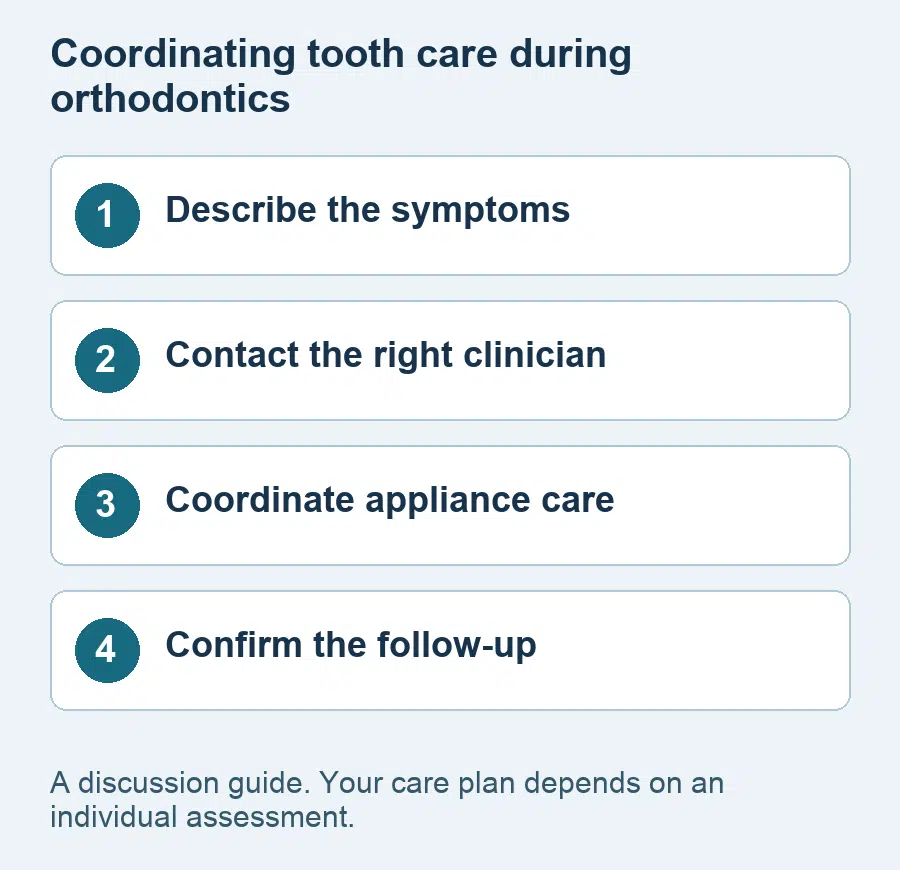
Five steps if you develop tooth pain during orthodontics
- Check the symptoms and urgency. Serious swelling, trauma or breathing and swallowing difficulty changes the response needed.
- Contact the appropriate dental team. Describe the tooth, timing, triggers and any appliance issue.
- Share the current treatment details. Include recent adjustments, tray stage and relevant dental history.
- Follow the assessment and coordination plan. Know who manages the tooth and who gives appliance instructions.
- Confirm follow-up. Ask about the definitive restoration, orthodontic reviews and any changes to the plan.
A useful handover prevents each team from assuming the other has handled the concern. Keep a written note of the next appointment and whom to contact if symptoms change.
What root-canal care may involve
If the dentist or endodontist recommends root-canal treatment, ask why it is needed, what alternatives apply and how the tooth will be restored afterward. The full plan may involve more than one appointment or clinician.
Clarify whether the quoted scope includes the final restoration or whether another dentist will provide it. A tooth’s long-term plan depends on the remaining structure and findings; this article cannot tell you whether a crown or another restoration is required.
Ask how ongoing orthodontic care fits the sequence. Do not assume that a treated tooth automatically prevents all future orthodontics or that treatment can continue unchanged without review.
Use comfort advice without delaying assessment
A clinician or pharmacist can advise on appropriate pain relief for your age, health and medicines. This guide does not provide a personalized medicine choice or dose. Avoid using leftover prescriptions or placing household substances against the tooth.
Temporary relief does not establish the cause. Persistent, severe or worsening symptoms still need assessment. If the condition becomes urgent, seek the appropriate service rather than waiting for the next scheduled adjustment.
Keep routine dental care during orthodontics
Orthodontic reviews do not replace dental checkups, cleanings or treatment of disease. Continue preventive care and tell both teams about relevant changes. This is especially useful when another restoration is planned or a tooth has a history of symptoms.
Halabi’s treatment-options information describes its orthodontic services. Use the contact page to ask about appliance coordination or the appropriate assessment route. Confirm dental and endodontic services directly with the clinicians providing them.
Frequently asked questions
Does an orthodontist usually provide root canals?
Root-canal care is usually handled by a general dentist or endodontist. Ask the actual practice about services and referral arrangements.
Does pain after an adjustment prove it is only braces soreness?
No. A painful tooth can have another cause. Describe the symptoms and ask which professional should assess them.
Can root-canal care be coordinated with braces?
The clinicians can assess and coordinate the sequence where appropriate. Do not remove or alter orthodontic components yourself.
Should I change an aligner around a dental procedure?
Follow case-specific instructions from the treating teams. Do not trim, skip or force a tray to accommodate a change.
What symptoms need urgent help?
Significant swelling, serious trauma, severe or worsening pain or signs of a spreading problem need timely assessment. Breathing or swallowing difficulty is an emergency.



 What patients are saying
 Your smile our passion
 News and Events
