


You can generally request an orthodontic consultation without waiting for a dentist to refer you. That does not mean every insurance plan, intake process or benefit works the same way. Booking an appointment and receiving coverage are separate questions.

For Brooklyn patients and parents, the simplest approach is to ask the practice about intake, check any insurance requirements and bring useful medical and dental information. This guide explains those steps and why ongoing care with your regular dentist remains important even when you book directly.
A referral can be helpful without being the only route
A dentist may recommend an orthodontic assessment after noticing crowding, a bite concern, eruption changes or another finding. That information can help the orthodontist understand the reason for the visit and coordinate care.
Patients can also ask for an assessment themselves. The American Association of Orthodontists’ choosing-care guidance explains the role of an orthodontic consultation. You do not need to diagnose your own bite or wait until a visible concern becomes severe before asking questions.
The practice should confirm its current booking process. If a particular service or circumstance requires additional information, ask what is needed and why.
Keep three questions separate
| Question | Who can clarify it? | Useful detail to obtain |
|---|---|---|
| Can I book an initial orthodontic assessment directly? | The orthodontic practice | Intake process, appointment type and required information |
| Does my plan require a referral or authorization for benefits? | The insurer or benefits administrator, with practice support | Plan-specific rules, eligible providers and written confirmation where available |
| Would information from my regular dentist help? | The dental and orthodontic teams | Relevant history, findings and records transferred appropriately |
| Is another dental concern urgent? | The appropriate dental or medical service | Timing of assessment and whether it should precede the routine consultation |
A “no referral needed” booking policy should not be read as a guarantee of insurance payment or confirmation that every test and treatment is included.
What to ask when calling the practice
Explain whether the appointment is for an adult or child and describe the main concern. Mention earlier orthodontic care, a current appliance or a possible transfer. An active-treatment problem may need a different appointment from a new-patient consultation.
Ask what to bring, whether records are requested in advance, the consultation fee if any and how long to allow. Do not assume imaging is free or that every first visit includes the same records. The clinician selects appropriate assessment based on the needs.
If you are asking about a service-area location, confirm the actual office address. A page relevant to your neighborhood does not necessarily mean every appointment takes place there.
Check insurance before making financial assumptions
Contact the insurer about your own plan. Ask whether orthodontic benefits exist, whether age restrictions or waiting periods apply and whether a referral or preauthorization is required. A plan may have a lifetime orthodontic maximum or other conditions that differ from routine dental coverage.
Clarify whether the provider arrangement affects benefits and whether the initial assessment and later treatment are handled differently. Record who you spoke with and the relevant reference information if available.
An estimated benefit is not necessarily a guarantee of payment. The practice can help explain its billing process, but the actual plan rules and agreement determine your financial responsibility.
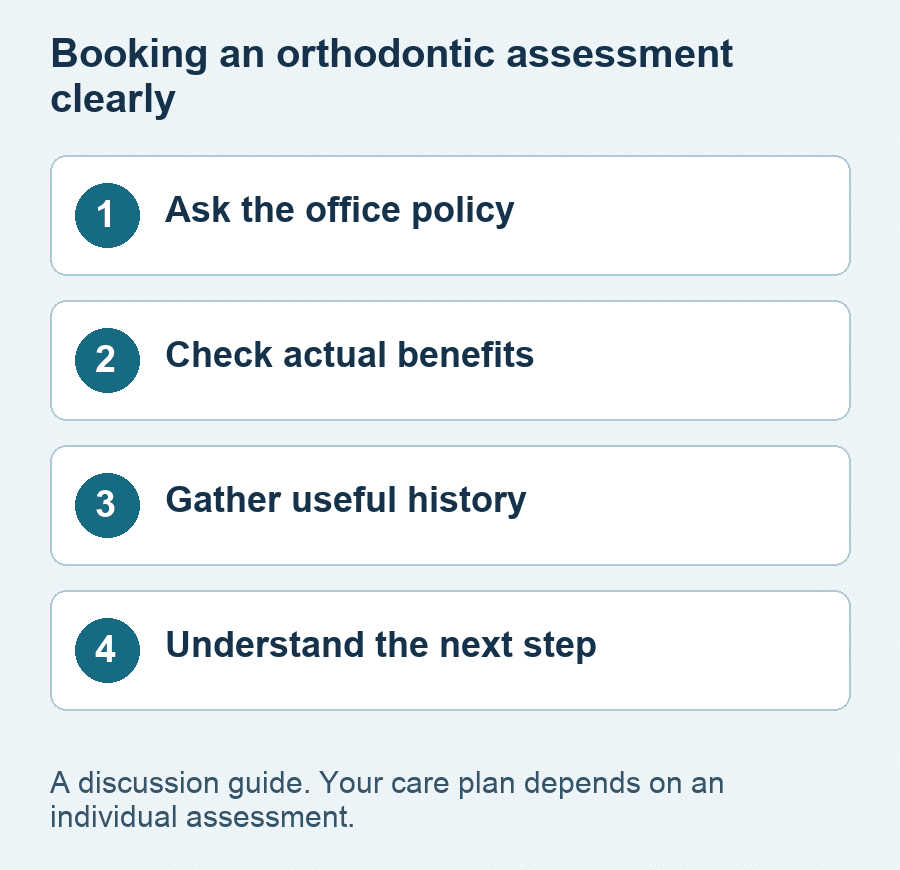
Prepare in three practical steps
- Ask the office about intake. Confirm direct booking, appointment type, fees and required information.
- Check your benefits separately. Ask the insurer about referral, authorization, eligibility and payment assumptions.
- Gather useful history. Bring medical information, dental history, prior orthodontic details and records requested through the appropriate process.
This keeps administrative questions from replacing the clinical conversation. You should still ask what the examination finds and why the next step is recommended.
What the consultation can lead to
The AAO’s first-appointment information describes the general assessment process. The clinician may recommend monitoring, oral-health preparation, further records or a discussion of treatment options.
For a child, development and eruption can influence timing. An initial assessment does not automatically mean immediate braces. For an adult, gum health, restorations and other dental needs may affect suitability and sequencing.
Ask for the findings in plain language. If treatment is proposed, compare its goals, alternatives, limitations and responsibilities before choosing an appliance or payment plan.
Your regular dentist remains part of care
Direct access to an orthodontist does not replace preventive examinations, cleaning or treatment of dental disease. Keep routine dental appointments and tell both teams about relevant problems or planned procedures.
A dentist may need to address decay or gum concerns before tooth movement. Another procedure may need to be coordinated during or after orthodontics. Ask who is responsible for each part rather than assuming one clinician handles everything.
If previous records would help, arrange transfer with appropriate permission. Do not assume an old scan can always be reused or that every record must be repeated.
Do not use a routine consultation to delay urgent care
Severe tooth pain, significant swelling or an injury may need prompt dental assessment before an ordinary alignment visit. Difficulty breathing or swallowing and other serious emergency symptoms require urgent medical help.
When you call, describe those symptoms directly. The fact that you want orthodontic care does not establish that the current problem is orthodontic or safe to leave until the next available consultation.
Begin with a clear enquiry
Halabi’s consultation page and contact information can help you confirm the current booking process. Ask about the actual location, intake requirements and payment arrangements for your circumstances.
You do not have to know which appliance you need before enquiring. The useful goal of the appointment is to understand the findings and the next appropriate step.
Frequently asked questions
Must my dentist refer me before I ask for a consultation?
Generally, patients can request an orthodontic assessment directly. Confirm the practice’s intake process and any circumstances requiring additional information.
Does direct booking mean insurance will pay?
No. Benefits, referral rules, authorization and eligible providers depend on the actual insurance plan.
Should I bring a dentist’s referral if I have one?
Yes, if the practice requests it. Relevant findings and records can help coordinate care even when direct booking is possible.
Does an initial consultation always lead to treatment?
No. The recommendation may be monitoring, preparation, further assessment or comparing suitable options.
Can I stop seeing my general dentist after booking orthodontics?
No. Preventive care and treatment of dental disease continue alongside orthodontic assessment or treatment.



 What patients are saying
 Your smile our passion
 News and Events
