


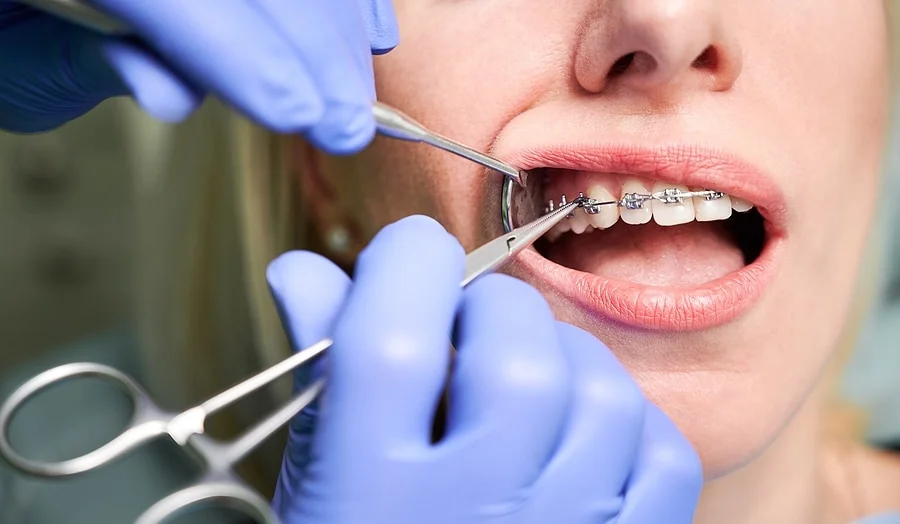
You wake up with a sore jaw. You hear a click every time you open your mouth wide. Headaches come on without obvious cause and seem to start around your ears rather than your forehead. If any of that sounds familiar, you may have been told it is TMJ. The question that follows is almost always the same: can braces fix it?
Understanding what TMJ treatment with braces actually involves is the first step toward a real answer. For patients exploring braces treatment in Brooklyn, Dr. Eli Halabi at Halabi Orthodontics has been addressing bite-related jaw problems for over 20 years from his Kings Highway practice.
What Is TMJ and What Is Actually Causing Your Pain?
TMJ stands for temporomandibular joint, the hinge on each side of your skull that connects your jaw to your head. Almost everyone has TMJ. What people usually mean when they say TMJ is temporomandibular disorder (TMD), a condition where the joint, disc, or surrounding muscles are not functioning correctly.
The causes vary significantly. Bite misalignment, jaw clenching, teeth grinding (bruxism), stress, injury, and arthritis can all contribute. The reason this matters for treatment planning is that TMJ treatment with braces addressing specifically is the bite. Braces correct the way upper and lower teeth meet, which relieves the chronic muscle strain and joint loading that biting incorrectly causes over time. When bite problems are a primary contributor, braces treatment can produce significant symptom relief. When the cause is stress-driven bruxism or joint damage unrelated to bite, braces play a supporting role rather than a primary one.
When Braces Can Fix TMJ: The Bite Connection
The most direct connection between bite misalignment and TMJ symptoms involves how the jaw compensates to bring teeth together. When your bite is off, whether through an overbite, underbite, crossbite, or open bite, your jaw muscles work harder and in asymmetric patterns on every chew, every swallow, and every time you close your mouth. Over months and years, this produces joint inflammation, muscle fatigue, and the clicking, popping, or locking that defines TMD.
| Bite Issue | How It Affects the Jaw | Braces Fix? |
|---|---|---|
| Deep overbite | Compresses the joint posteriorly, strains supporting muscles | Yes, strong candidate |
| Underbite | Displaces the lower jaw forward, creates asymmetric forces | Yes, often with elastics |
| Crossbite | Forces lateral jaw shift, loads one side more than the other | Yes, very effective |
| Open bite | Causes compensatory muscle overwork to close | Yes, partial improvement |
| Bruxism alone | Stress-driven grinding, bite may be fine | Supporting role only |
| Joint damage / arthritis | Structural problem within the joint itself | Adjunct treatment only |
What Is TMJ Treatment with Braces Like at Halabi Orthodontics?
When a Brooklyn patient comes to Halabi Orthodontics with TMJ symptoms, Dr. Halabi’s approach starts with a thorough clinical and bite assessment before any braces treatment is recommended. The goal is to identify whether bite misalignment is a primary driver of the symptoms. If it is, the treatment plan targets the bite relationships specifically responsible. Here are the braces options available for TMJ-related correction:
Colorful Metal Braces
Colorful metal braces offer the most mechanical control of any fixed appliance, making them the strongest option for complex bite corrections involving significant overbite, underbite, or multiple contributing factors. For TMJ patients who need precise bite repositioning, metal braces with elastics give Dr. Halabi the most tools to work with.
Clear Ceramic Braces
Clear ceramic braces deliver the same bite-correcting capability as metal braces with tooth-colored brackets that are far less visible. For adult Brooklyn patients who want effective TMJ-related bite correction without the appearance of metal hardware, ceramic braces are a strong option.
Lingual Braces

Lingual braces are bonded to the inside surfaces of the teeth, making them completely invisible from the outside. For patients dealing with both TMJ symptoms and professional or social concerns about visible braces, lingual braces offer fixed appliance correction with no visual impact.
Damon Braces
Damon braces use a self-ligating system that reduces friction compared to conventional brackets. For TMJ patients where comfort is a significant concern during treatment, the lighter forces of the Damon system can make the process more manageable while still achieving the bite correction needed.
Does braces treatment change your face? Bite correction for TMJ can involve repositioning the jaw, which may subtly change how the face looks in profile. This is generally a positive change. The full guide to how braces change your face covers what to realistically expect.
Cost of TMJ Treatment with Braces in Brooklyn
The cost of braces treatment at Halabi Orthodontics in Brooklyn typically ranges from $2,000 to $6,000 depending on the type of braces, the complexity of the case, and the estimated treatment length. TMJ-related bite corrections may fall toward the mid to upper range if the bite discrepancy is significant and requires a longer treatment period. A complete cost breakdown is provided at your complimentary consultation before any commitment.
| Braces Type | Typical Cost Range (Brooklyn) | TMJ Suitability |
|---|---|---|
| Metal braces | $2,000 to $5,000 | Strongest bite correction capability |
| Ceramic braces | $3,000 to $6,000 | Full bite correction, discreet |
| Lingual braces | $5,000 to $8,000+ | Invisible, complex cases handled |
| Damon braces | $3,500 to $6,000 | Comfortable, self-ligating |
How Long Does Braces Treatment for TMJ Take?

Most comprehensive braces treatment at Halabi Orthodontics takes 18 to 24 months. TMJ-related bite correction does not necessarily take longer than standard treatment, though cases involving significant overbite or skeletal underbite can extend toward 24 to 30 months. Dr. Halabi provides a personalized timeline at the consultation based on your specific bite presentation and the braces system chosen.
One factor that can meaningfully accelerate treatment is Acceledent or Propel, two technology options available at Halabi Orthodontics that stimulate bone remodeling and can reduce total treatment time by up to 40 percent. For patients eager to resolve their TMJ symptoms as efficiently as possible, these accelerators are worth discussing at the initial visit. If you are concerned about discomfort during treatment, the do braces hurt guide explains what to expect honestly at each stage.
What to Expect: Step by Step
- Free consultation. Dr. Halabi evaluates your bite, jaw function, and TMJ symptoms. He identifies whether bite misalignment is a primary contributor and recommends a braces approach with a full timeline and cost estimate.
- Diagnostic records. Digital scans, X-rays, and photographs map your bite precisely and form the foundation of your TMJ-targeted treatment plan.
- Braces placed. Brackets are bonded at a single appointment. Dr. Halabi explains what the bite correction phase will involve and when you can expect to notice symptom improvement.
- Bite correction phase. Elastics and wire progressions target the specific bite relationships driving TMJ symptoms. This is the most important phase for joint relief.
- Finishing. Fine-tuning tooth positions for both bite function and appearance.
- Retention. Retainers after treatment maintain your bite correction permanently. For bruxism patients, a night guard is often recommended alongside the retainer.
Dr. Eli Halabi: Braces Treatment in Brooklyn, NY
Dr. Halabi earned his DMD from the University of Pennsylvania (top of his class, 2005), completed his orthodontic specialty training at George Washington University, and his residency at Children’s National Medical Center. He is a member of the American Association of Orthodontists, lectures and publishes in the orthodontic community, and has earned over 200 five-star reviews from Brooklyn patients. For residents seeking TMJ-related braces treatment in Brooklyn, Halabi Orthodontics on Kings Highway is the starting point for an honest clinical assessment and a personalized treatment plan.
Address: 575 Kings Highway, Brooklyn, NY 11223
New Patients: (718) 550-6832
Current Patients: (718) 676-5000
Book Your Free TMJ Braces Consultation at Halabi Orthodontics
Frequently Asked Questions
What is TMJ treatment with braces and how does it work?
TMJ treatment with braces corrects bite misalignment that is placing chronic strain on the temporomandibular joint and surrounding muscles. By repositioning how the upper and lower teeth meet, braces relieve the compensatory jaw movement that drives clicking, pain, and muscle fatigue. The treatment targets the specific bite relationships causing the problem, using elastics alongside the braces to guide the jaw into a better position.
Can all types of braces fix TMJ, or is one better?
All fixed appliance types can address TMJ-related bite problems. Metal braces offer the most mechanical control for complex corrections. Ceramic and lingual braces achieve the same outcomes with less visibility. Damon braces provide a more comfortable experience through reduced friction. Dr. Halabi recommends the right system at your consultation based on your specific bite presentation and preferences.
How long does braces treatment for TMJ take in Brooklyn?
Most cases take 18 to 24 months. The specific timeline depends on the severity of the bite discrepancy and which braces system is used. Acceledent and Propel acceleration technology, both available at Halabi Orthodontics in Brooklyn, can reduce treatment time by up to 40 percent for eligible patients.
What does braces treatment for TMJ cost in Brooklyn, NY?
Braces treatment at Halabi Orthodontics typically ranges from $2,000 to $6,000 depending on the type of braces and case complexity. Dr. Halabi provides a complete cost breakdown at the free consultation. The practice accepts most insurance plans and offers flexible payment arrangements including interest-free financing options.
Will braces completely cure my TMJ symptoms?
If bite misalignment is the primary cause, braces treatment can significantly reduce or resolve TMJ symptoms. If multiple factors are contributing, such as stress-driven bruxism or existing joint damage, braces address the bite component while other approaches, including night guards or physical therapy, manage the remaining causes. Dr. Halabi gives you an honest assessment of what braces can and cannot accomplish for your specific situation.

 What patients are saying
 Your smile our passion
 News and Events