


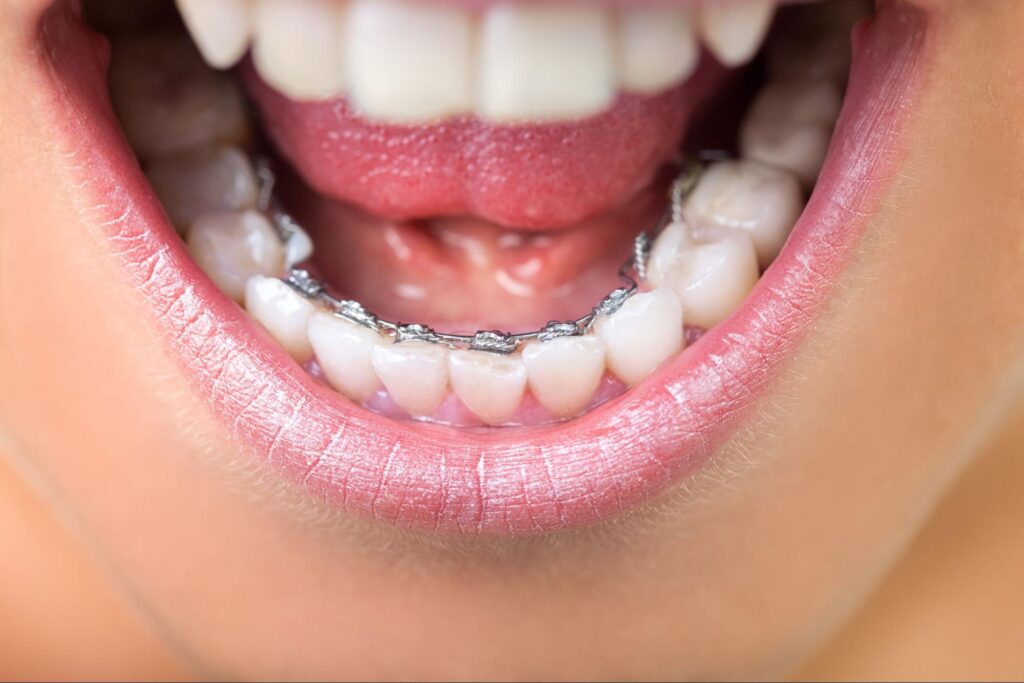
Most adults who want orthodontic treatment quietly rule out braces before the consultation even happens. The reasoning is predictable: brackets on teeth, visible hardware, questions from colleagues and clients. What most of them do not know is that an option exists where none of that is true. Lingual braces in Brooklyn at Halabi Orthodontics are bonded entirely to the inside surface of the teeth, making them completely invisible from every external angle. The fixed appliance precision is the same as traditional braces. The visibility is zero. For adults in Brooklyn who have been waiting for a treatment that fits their life, this is often the answer they did not know to ask for.
What Are Lingual Braces and How Do They Work?
Lingual braces use the same fundamental mechanics as conventional fixed braces: brackets bonded to teeth, an archwire threaded through them, and gradual controlled tooth movement over time. The only difference is where the brackets sit. Instead of bonding to the outer face of each tooth, lingual brackets are bonded to the tongue-side surface, completely behind the teeth.
From the front, the smile looks completely untreated throughout the entire duration of orthodontic care. No visible metal. No ceramic brackets. No one across the conference table or at the dinner party knowing you are in treatment unless you tell them. That is why adults use lingual braces over every other option when complete invisibility with fixed appliance control is the priority.
Not the same as Invisalign: Lingual braces are fixed. They work continuously, 24 hours a day, without depending on patient compliance. Invisalign requires 20 to 22 hours of daily wear. For cases where precise fixed control produces a better outcome, lingual braces deliver that without any of the visibility of conventional braces.
Why Use Lingual Braces? Five Reasons Adults Choose Them

1. Complete Invisibility With Fixed Precision
The primary reason is the one most people already know: they cannot be seen. What is less understood is that lingual braces provide fixed appliance precision that Invisalign does not always match for complex cases. For adults with significant bite corrections, more involved crowding, or torque requirements that push the limits of aligner therapy, lingual braces in Brooklyn offer the best of both worlds: hidden treatment and clinical control.
2. No Compliance Required
Clear aligners only work when they are worn. Lingual braces work continuously whether you think about them or not. For busy adults in Brooklyn who know their own patterns well enough to doubt their aligner compliance, lingual braces remove the variable entirely. The treatment progresses on schedule without any daily decision-making.
3. No Food Restrictions Around Social Life
Conventional braces require avoiding hard and sticky foods for the duration of treatment. Lingual braces carry the same restriction in principle, but because the brackets are on the inside of the teeth, minor bracket contact during eating is significantly less likely from natural biting forces. The dietary guidance is similar, but the positioning reduces the risk from everyday eating patterns.
4. Suitable for Complex Cases That Aligners Cannot Fully Address
One of the most common misconceptions about lingual braces is that they are a cosmetic option for simple cases. In practice, lingual braces can address the same range of complex presentations as conventional braces, including significant crowding, bite corrections, and cases requiring precise root torque. For adults whose complexity has ruled out aligner therapy, lingual braces are a genuinely viable alternative.
5. The Adjustment Period Is Finite
The most honest thing to say about lingual braces is that the first two to four weeks involve a real adjustment. The tongue is not accustomed to brackets on the inside surfaces of teeth, and speech is temporarily affected. Most patients notice a lisp that resolves within a few weeks as the tongue adapts. Knowing this upfront makes the adjustment period manageable. Understanding whether braces hurt during this period is a question worth reviewing before starting treatment.
Lingual Braces vs. the Alternatives: A Direct Comparison
| Factor | Lingual Braces | Traditional Braces | Invisalign |
| Visibility | Completely hidden | Fully visible | Nearly invisible |
| Fixed or removable | Fixed | Fixed | Removable |
| Compliance required | None | None | 20 to 22 hours daily |
| Case complexity range | Full range | Full range | Mild to moderate |
| Food restrictions | Same as braces | Hard and sticky avoided | None when removed |
| Speech adjustment | Temporary 2 to 4 weeks | Minimal | Minimal |
| Specialist credentials needed | Yes, advanced training | Standard | Standard certification |
The specialist credentials point in the table above is not a minor detail. Lingual braces require advanced training beyond standard orthodontic certification. The brackets are smaller, placed in a more technically demanding position, and require a different clinical approach to achieve precise tooth movements. Not every orthodontist offers them.
Cleaning Lingual Braces: What You Need to Know

Cleaning around lingual brackets is the most practical challenge of the treatment. The tongue-side surfaces of the teeth are less accessible than the outer surfaces, which means standard brushing habits need to be supplemented with proximal cleaning tools. The step-by-step lingual braces cleaning guide at Halabi Orthodontics covers exactly what tools to use and how to use them, which is one of the most useful things to read before starting lingual treatment.
- Interdental brushes: reach under the archwire on the tongue side where a regular toothbrush cannot
- Water flosser: significantly easier than threading floss behind lingual brackets
- Fluoride mouthwash: adds a layer of enamel protection in areas that are harder to clean mechanically
- Brush after every meal: food trapping on the tongue side of brackets is the primary hygiene risk throughout treatment
Patients who maintain consistent hygiene throughout lingual treatment arrive at debonding with enamel in excellent condition. The challenge is real but entirely manageable with the right tools and habits from day one.
Who Is a Good Candidate for Lingual Braces in Brooklyn?
Lingual braces are not the right choice for every case or every patient. Good candidates typically include:
- Adults in professional or public-facing roles: anyone for whom visible braces would affect professional confidence or client perception
- Adults with moderate to complex alignment or bite needs: cases that go beyond what aligner therapy can reliably address
- Patients who struggle with compliance: anyone who would not reliably wear aligners 20 to 22 hours per day
- Patients who want fixed results without the visibility: the combination that no other option fully delivers
Lingual braces are generally not recommended for patients with very small teeth, those with severe jaw discrepancies requiring surgery, or very young patients whose teeth are still developing. Dr. Eli Halabi assesses candidacy at the consultation and gives a direct recommendation based on what the case actually requires.
Lingual Braces in Brooklyn at Halabi Orthodontics
Dr. Eli Halabi at Halabi Orthodontics on Kings Highway offers lingual braces in Brooklyn for adult patients who want specialist-level orthodontic care without any visible hardware. The practice offers the full range of treatment options so every recommendation is made based on what your case needs, not a default toward one system. Free consultations are available for new patients at both phone numbers below.
Address: 575 Kings Highway, Brooklyn, NY 11223
Current Patient: (718) 676-5000
New Patient: (718) 550-6832
Book Your Lingual Braces Consultation at Halabi Orthodontics
Frequently Asked Questions About Lingual Braces
Why use lingual braces instead of Invisalign?
The main reasons adults use lingual braces over Invisalign are fixed precision for complex cases, no compliance requirement, and complete invisibility with the same clinical control as conventional braces. For cases that go beyond what aligner therapy can reliably address, lingual braces deliver hidden treatment without compromising the clinical outcome.
Do lingual braces affect speech?
Yes, temporarily. Most patients experience a noticeable adjustment in speech for the first two to four weeks as the tongue adapts to the bracket surfaces. A lisp is the most common effect. It resolves on its own as the tongue adjusts and does not require any specific intervention.
Are lingual braces more expensive than regular braces?
Yes. Lingual braces require advanced clinical training, more technically demanding placement, and specialized brackets, all of which make them more expensive than conventional fixed braces. The cost is higher than standard braces and comparable to or slightly above Invisalign comprehensive cases. A full cost breakdown is provided at the consultation.
How long does lingual braces treatment take?
Most lingual braces cases run 18 to 24 months depending on case complexity. The timeline is comparable to conventional braces for similar presentations. Dr. Halabi provides a personalized estimate at the consultation based on your specific alignment and bite needs.
Can lingual braces fix a severe bite problem?
Yes. Lingual braces can address the same range of bite and alignment issues as conventional fixed braces, including significant crowding, overbite, underbite, and crossbite. This is one of the clinical advantages over aligner therapy, which has limitations on certain complex bite corrections.
Where can I get lingual braces in Brooklyn?
Halabi Orthodontics at 575 Kings Highway offers lingual braces in Brooklyn for adult patients with free consultations for new patients. Call (718) 550-6832 to schedule or book online.

 What patients are saying
 Your smile our passion
 News and Events